Hydrojetting in Vila Andrade: Pressure, Pipe Diameter and When It Wins
Pushing a clog with a snake moves the blockage; washing the pipe wall clean removes the grease film that caused it. That single contrast explains why a desentupidora Vila Andrade São Paulo SP crew reaches for a hydrojetting rig on some jobs and a mechanical auger on others. If you manage a building in Vila Andrade, the decision is not about which machine is stronger. It is about pressure, flow and the inside diameter of the pipe you are trying to save.
Vila Andrade sits in the southern zone of São Paulo, a district where 1970s residential towers, newer condominium blocks and busy commercial kitchens share the same underground network. Older cast-iron and PVC lines, grease-heavy restaurant drains and tree-root intrusion all behave differently under pressure. Understanding the physics lets a superintendent ask better questions before a crew arrives.
What Hydrojetting Actually Does Inside the Pipe
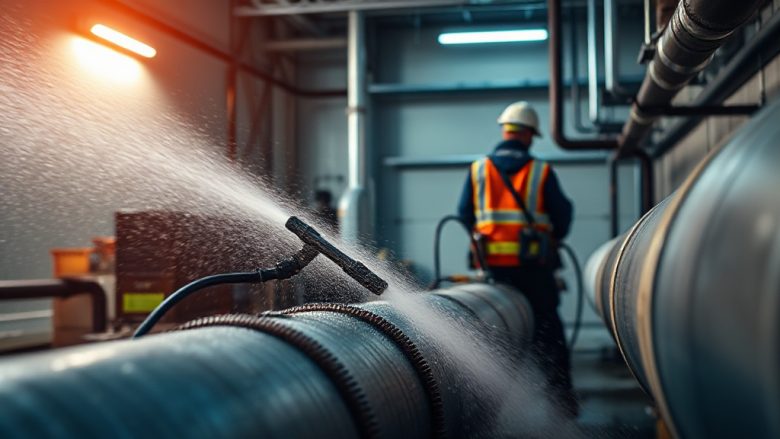
Hydrojetting uses a high-pressure water stream directed through a flexible hose and a specialized nozzle. The nozzle does not just push forward: rear-facing jets propel the hose while forward jets cut into the blockage. The result is a scouring action that strips grease, scale, silt and roots from the pipe wall, restoring the original internal diameter.
Think of the pipe as a tunnel with a lining of debris. A mechanical snake punches a hole through the debris, so water can pass but the lining remains. Hydrojetting removes the lining itself. That is why the method is often described as cleaning rather than clearing.
Nozzle types and their job
The nozzle is the working end of the system, and its design determines what the water does. A penetration nozzle concentrates force forward to break through a solid clog. A flusher nozzle uses rear jets to wash debris back toward the access point. A chain cutter nozzle adds mechanical cutting for roots. Choosing the wrong nozzle wastes pressure and can damage fragile pipe.
Why flow matters as much as pressure
Pressure alone does not clean a pipe. Flow volume carries the loosened debris to the nearest manhole or access point. A high-pressure, low-flow jet can cut a channel but leave the waste behind. A balanced combination of pressure and flow is what makes hydrojetting effective on long horizontal runs.
The Physics of Pressure and Pipe Diameter
Water pressure is force per unit area. In a hydrojetting system, that force is delivered through a small orifice at the nozzle, and the resulting velocity determines how aggressively the water hits the blockage. But the pipe diameter changes everything. A 100 mm (4-inch) line has roughly four times the cross-sectional area of a 50 mm (2-inch) line, so the same flow rate produces a very different scouring effect.
In narrow pipes, pressure must be moderated to avoid etching or cracking the wall, especially in older cast iron. In larger mains, higher flow is needed to maintain velocity and carry debris. This is why a crew should measure or confirm the pipe diameter before selecting a pressure setting.
Pressure ranges in practice
Most residential and light commercial hydrojetting falls between 1,000 and 4,000 psi. Delicate older lines may be cleaned at the lower end, while heavy grease in a restaurant drain may require a higher setting with a rotating nozzle. The exact figure depends on pipe material, age and the nature of the blockage, not on a single universal number.
Describing the setup in prose
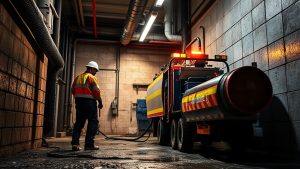
Picture the rig: a truck-mounted pump draws from a water tank, feeds a high-pressure hose reel, and the hose enters the pipe through a floor drain or cleanout. The nozzle sits at the tip, jets angled backward to pull itself forward and forward to cut. The operator watches the return flow at the access point; when the water runs clear, the wall is clean.
Vila Andrade’s Pipe Mix: Older Blocks and Commercial Kitchens
Vila Andrade is not a single type of neighborhood. The district includes established residential buildings with decades-old drainage, newer condominiums with modern PVC, and a commercial corridor where restaurants and shops generate heavy grease loads. Each setting creates a different failure pattern.
In older residential blocks, the enemy is often scale and root intrusion. Cast-iron pipes corrode internally, narrowing the bore. Tree roots find joints and hairline cracks, entering in search of moisture. In commercial kitchens, the enemy is grease: fats, oils and food solids cool and congeal on the pipe wall, gradually reducing diameter until flow stops.
Residential buildings
For a superintendent in a 1980s tower, hydrojetting is a way to restore capacity without digging. A camera inspection first confirms the pipe material and condition. Then a moderate-pressure pass with a flusher nozzle removes scale and silt. If roots are present, a chain cutter nozzle is used before a final wash.
Commercial kitchens
Restaurant drains demand a different approach. Grease traps must be maintained, but the line downstream still accumulates a hard grease cap. Hydrojetting at higher pressure with a rotating nozzle breaks that cap and washes the wall clean. Scheduling this before the lunch rush avoids emergency shutdowns.
When Hydrojetting Wins and When It Does Not
Hydrojetting is not a universal answer. It wins when the goal is full-bore cleaning: grease, scale, silt, roots and soft debris. It loses when the pipe is structurally compromised, when the blockage is a solid object that cannot be flushed, or when access is inadequate.
A skeptical superintendent should ask three questions before approving the job: What is the pipe material and diameter? Has a camera inspection been done? What pressure and nozzle will be used? The answers separate a targeted cleaning from a risky guess.
Comparison at a glance
| Method | Best for | Limitation |
|---|---|---|
| Mechanical snake | Solid clogs, quick access | Leaves wall debris |
| Hydrojetting | Grease, scale, roots, full cleaning | Needs water access and sound pipe |
| Camera inspection | Diagnosis before cleaning | Does not clean by itself |
For a building that has repeated backups in the same line, hydrojetting plus camera verification is usually the more durable fix. For a single isolated clog in a healthy pipe, a snake may be enough.
Preparing a Vila Andrade Building for a Hydrojetting Visit
Preparation reduces risk and time. The crew needs clear access to cleanouts, floor drains and manholes. If the cleanout is buried under a slab or behind a wall, that must be addressed first. Water supply for the jetter tank should be confirmed, and residents should be warned that fixtures may gurgle or spray during the process.
It also helps to document the building’s drainage layout. A simple sketch of stacks, branches and cleanouts lets the operator choose the entry point that reaches the blockage with the shortest hose run. Shorter runs preserve pressure at the nozzle.
Safety and structural checks
Before any high-pressure work, the pipe condition should be assessed. A camera inspection reveals cracks, collapsed sections or illegal connections. Hydrojetting a deteriorated pipe can cause a blowout. This is why a reputable desentupidora Vila Andrade team will inspect before pressurizing.
What residents should expect
Expect noise from the pump, temporary water interruptions and a period of gurgling as air escapes. After cleaning, a final camera pass confirms the wall is clear. If roots were cut, a follow-up treatment may be recommended to slow regrowth.
Maintenance: Keeping the Clean Pipe Clean
Hydrojetting restores capacity, but it does not prevent recurrence. Grease returns, roots regrow and silt accumulates. A maintenance schedule based on pipe use is the only way to protect the investment. For commercial kitchens, quarterly cleaning of grease-heavy lines is common. For residential buildings, an annual camera check on the main stack catches problems early.
Simple habits help: never pour cooking oil down the drain, use strainers in sinks and showers, and report slow drains before they become backups. A slow drain is the early warning that the pipe wall is narrowing.
Preventive hydrojetting versus emergency calls
Emergency calls cost more because they happen at inconvenient times and often after damage has begun. Preventive hydrojetting is scheduled, predictable and cheaper per visit. For a condominium, a maintenance contract with a desentupidora em Vila Andrade São Paulo SP spreads the cost and keeps the network on a known schedule.
Choosing a Crew That Understands the Physics
The difference between a good and a mediocre hydrojetting job is rarely the machine. It is the operator’s judgment about pressure, nozzle and pipe condition. A crew that asks about pipe diameter, reviews camera footage and adjusts pressure accordingly is protecting the building. A crew that arrives with one setting for every job is guessing.
In Vila Andrade, where old and new construction sit side by side, that judgment matters more than in a uniform subdivision. The same district contains pipes that can handle 4,000 psi and pipes that should never see more than 1,500 psi. Knowing which is which is the craft.
When the water runs clear and the camera shows a smooth wall, the job is done. Not because the clog moved, but because the pipe was washed clean. That is the standard to hold any crew to.